The Base (Almost) Always Wins
What a Decade-Old Comic Tells Us About the Panic Over Generative AI

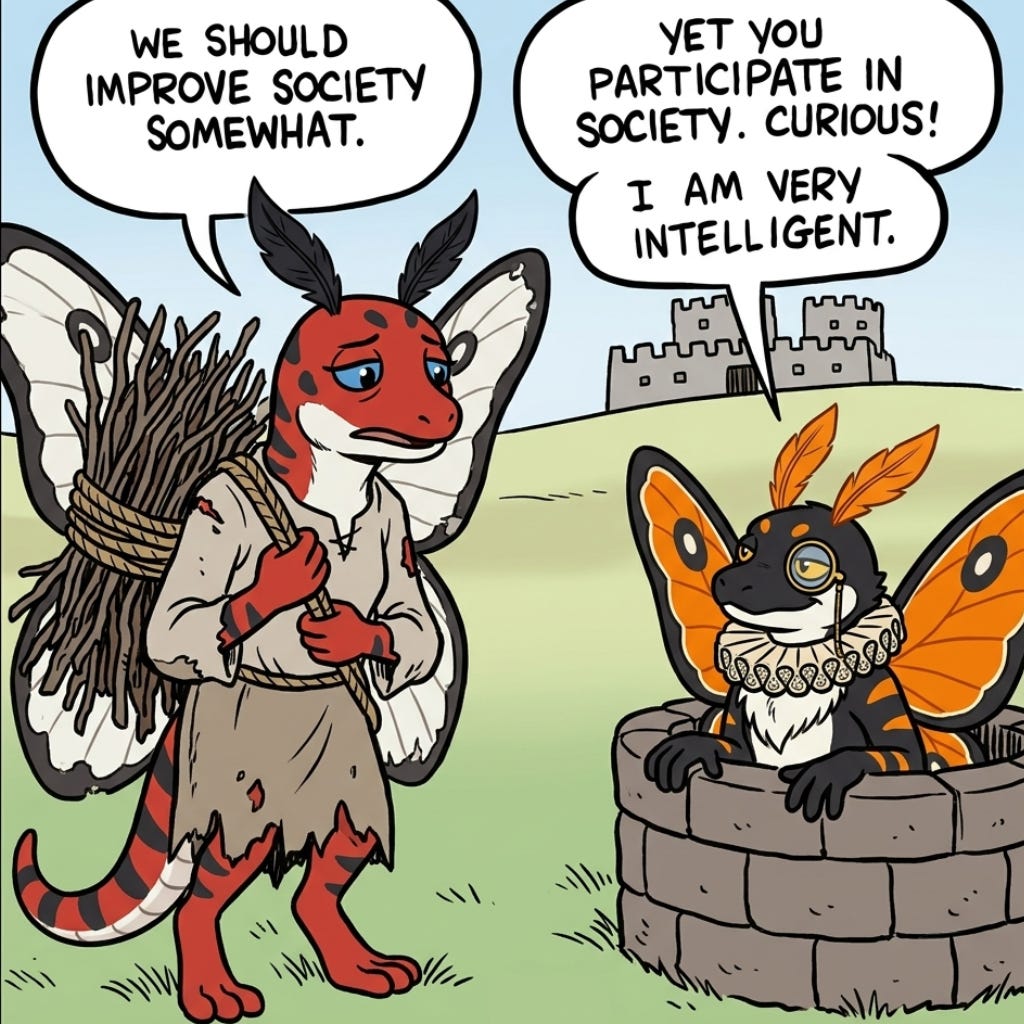
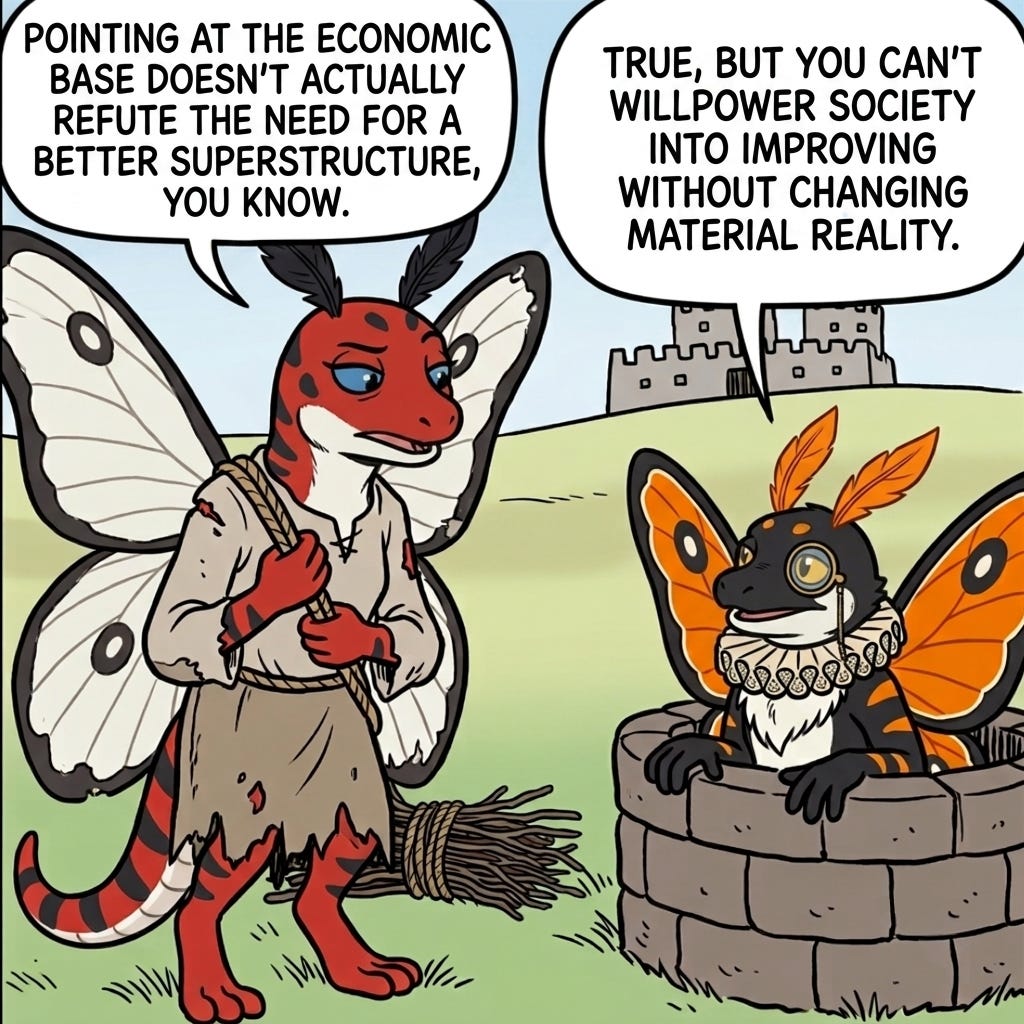
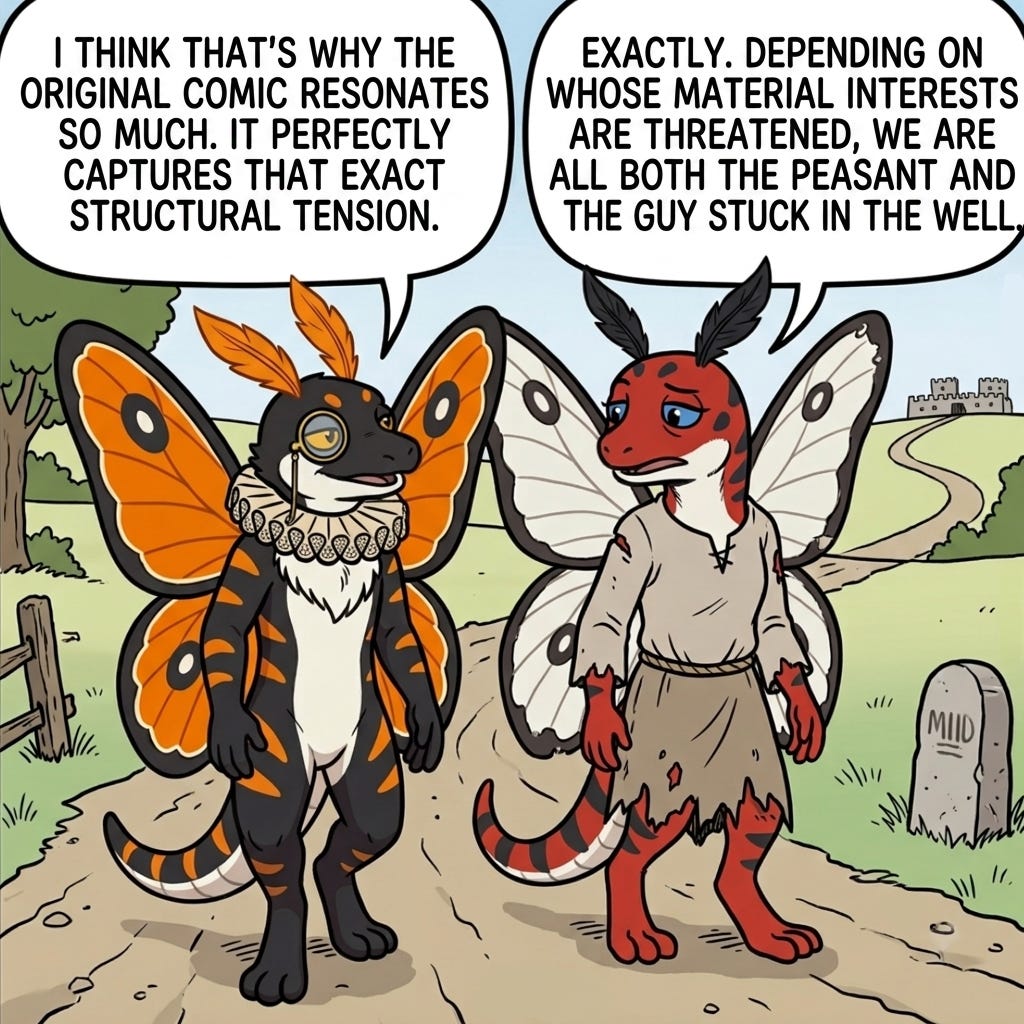
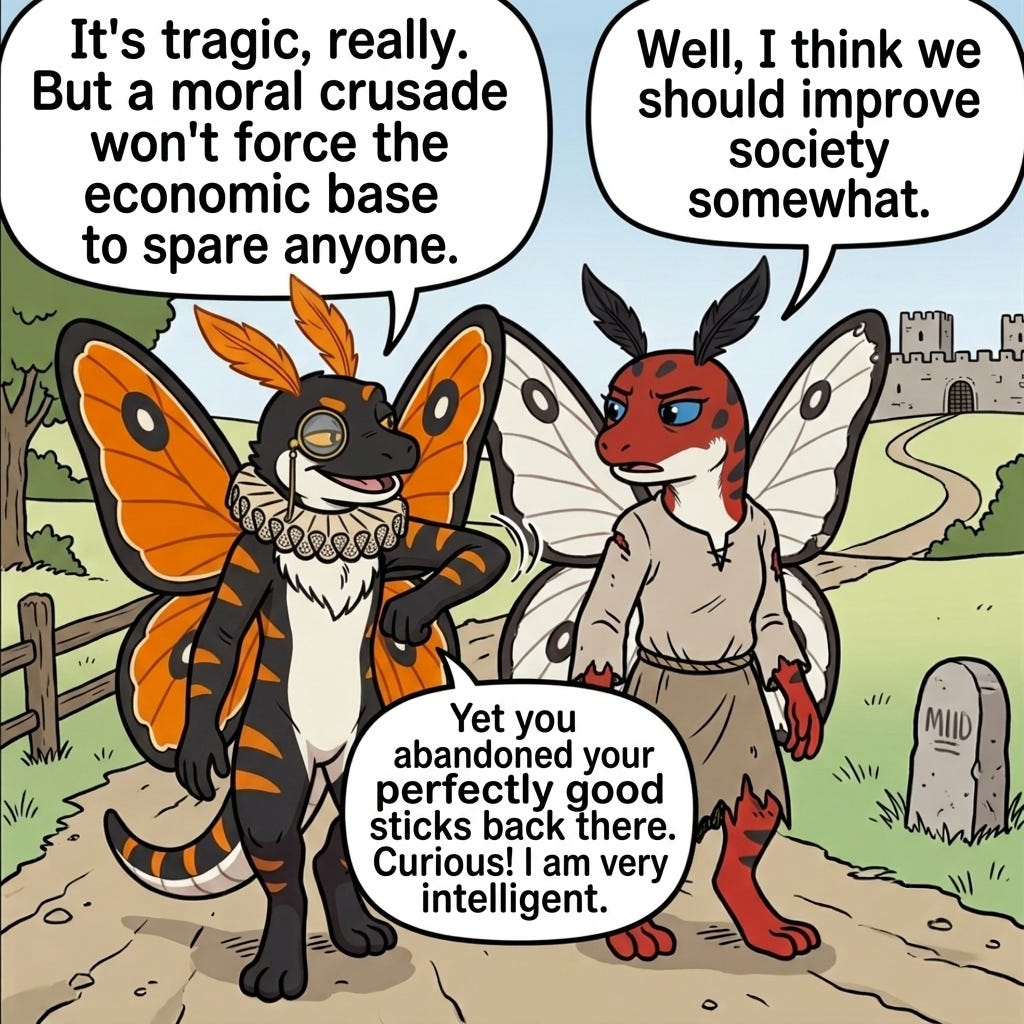
If you have spent any time in political or cultural debates online over the last decade, you know the image. The Mister Gotcha comic has been weaponized as the ultimate rhetorical shield.
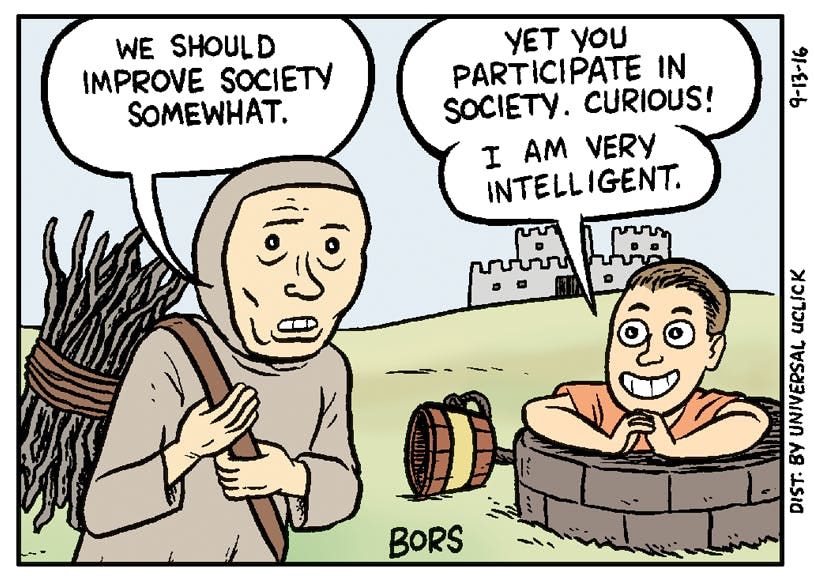
The setup is always the same: A heated argument breaks out. Someone suggests a systemic change or criticizes a capitalist institution. Their opponent chimes in to point out that they participate in and materially benefit from the very system they are critiquing. In response, the original poster drops this comic like a mic, completely dismissing the criticism.
Matt Bors’s original intent for the comic is clear. It was designed to mock reactionary pedants who demand impossible ethical purity from people just trying to survive. In the progressive framework, "Mister Gotcha" is a bad-faith troll, and the peasant carrying the sticks is the righteous victim of circumstance.
But what if, after a decade of using this image as a shield, we have completely misunderstood the dynamic at play?
Mister Gotcha certainly isn't secretly reading Marxist theory in that well. His response is inherently reactionary. But he possesses a sharp, intuitive recognition of what is actually driving the car. When he says, "Yet you participate in society," he is pointing out that our actions contribute to how society runs collectively, and that radically changing the system will inevitably threaten the individual's specific, current position within it.
Neither the peasant nor Mister Gotcha has the complete picture, but accepting why they both represent a piece of the truth explains the most chaotic ideological identity crisis happening on the internet right now: the war over Artificial Intelligence.
The Base and the Superstructure
To understand this, we have to look past the moralizing of the comic and examine the structural reality it presents.
The peasant, stating, "We should improve society somewhat," is expressing a genuinely good thing. It is a necessary recognition that our current mode of living isn't ideal. They are operating entirely within the realm of the superstructure: expressing an ideological desire, a political goal, and a moral vision for a better world.
Mister Gotcha, however, is pointing directly at the base: the underlying economic relations and material realities of production. He recognizes that you cannot "improve society" through sheer willpower without grappling with the material reality that sustains you.
The irony is that people will pick a side in this dynamic and switch between them seamlessly depending on the argument. Idealists will spout the utopian desires of the peasant when posting on Twitter, but the second their material base is threatened, they climb right into the well and become Mister Gotcha.
Enclosing the Commons: The Delay of M-C-M'
This constant flip-flopping between the base and the superstructure is the exact engine driving the current panic over generative AI and intellectual property.
To understand why, we have to look at how capitalism handles ideas through the circuit of capital: M-C-M'. A capitalist starts with Money (M), uses it to produce a Commodity (C), and sells that commodity for Money Prime (M'), representing the original investment plus surplus value.
Crucially, there is a delay in this process where capital is sitting in commodities as unrealized gains. If a farmer spends capital planting apple trees, that wealth is stuck in the apples (C). If the apples rot before they are sold, the farmer absorbs the loss and is financially harmed.
When dealing with physical goods, the commodity is inherently scarce. But intellectual labor and digital art have a marginal cost of reproduction near zero. If an idea can be instantly duplicated, its exchange value crashes before the creator can extract M'.
Intellectual property law exists to artificially enclose information. It takes something naturally abundant and legally turns it into a discrete, excludable Commodity to protect those unrealized gains during the delay. Generative AI threatens to collapse this turnover time completely, plummeting the cost to produce C and evaporating the ability of traditional workers to extract a living wage.
Ideology as a Shock Absorber
This brings us to the massive ideological inversion happening today.
Faced with a direct threat to their material survival, left-leaning artists (who historically champion the intellectual commons and critique corporate monopolies) are now fiercely defending the most aggressive forms of copyright enforcement. To survive, their ideological superstructure has reshaped itself. The sheer panic surrounding AI is not just about a loss of income; it is the historical terror of proletarianization. Freelance artists occupy a petty-bourgeois position (owning their own skills and tools) and their fierce embrace of corporate IP law is a desperate attempt to avoid becoming gig-workers who merely touch up AI outputs for a wage.
The anti-AI crowd acts like the peasant on Twitter, demanding we save humanity from corporate algorithms, but the moment their unrealized gains are threatened, they align with the legal frameworks of corporations like Disney to protect their rent. They become Mister Gotcha.
But the pro-AI camp is doing the exact same thing, just from a different angle. The utopian pro-AI faction champions the abolition of intellectual property and the democratization of art (playing the peasant). Yet, while they may not always literally watermark their outputs, we frequently see pro-AI creators exhibiting the exact same fierce possessiveness over their AI-generated pieces, jealously guarding "their" work from being taken by others.
Furthermore, we must distinguish the utopian pro-AI consumer from the AI monopolists who actually own the base. While idealists post online about IP abolition, the corporate giants developing these models want copyright laws loosened just enough to allow frictionless data scraping, while demanding draconian legal protections for their own proprietary algorithms. As of this moment, the utopian pro-AI camp isn't aligned with the base. They want IP abolition, but you cannot simply will the abolition of intellectual property into reality any more than the anti-AI crowd can just make AI disappear.
The New Metallica
If ideology is just a map we draw after the fact to justify our material survival, is the discourse pointless?
No. Ideally, we would live in a world with more Kevin MacLeods and fewer Walt Disneys. But we must look at how intellectual property is born from actual material trauma…and how that trauma is subsequently weaponized.
Walt Disney did not become an IP hawk out of a vacuum; he became one because he lost the rights to Oswald the Lucky Rabbit. His labor was stolen by a distributor, and he vowed to never let capital dictate his ownership again. But while his reaction was rooted in genuine material loss, the resulting hawkishness is inexcusable. Disney’s trauma is precisely why our modern cultural landscape is violently cut up, enclosed, and parceled out like private real estate. His personal defense mechanism perversely scaled into the ruthless privatization of the public commons. Given the economic forces at play, this capitalist enclosure was always going to happen, but it remains a profound cultural tragedy; one born from ‘protecting artists’.
IP fulfills a specific purpose, and you cannot make it disappear without changing the underlying economic reality. This isn't just decided by market forces; intellectual property is ultimately enforced by the state's monopoly on violence. The likely synthesis of this conflict will be state regulation that protects massive tech monopolies and giant copyright holders, simultaneously crushing the independent artist and the open-source utopian alike.
When the internet was brand new, the MP3 format disrupted the music industry. Napster rubbed up against intellectual property, and Metallica (specifically Lars Ulrich) became the face of digital rights management, suing to enclose digital audio. Early internet culture mocked them relentlessly. But Metallica won, Napster was destroyed, and online piracy continued anyway until streaming synthesized a new economic reality.
Today, the anti-AI left finds itself echoing Metallica.
They aren't doing it out of corporate greed, but out of a desperate hope that the law will save them. They are aggressively defending the digital enclosure of information, hoping that expanding copyright law will act as a life raft to rescue them from the technological disruption of their commodity. The tragic difference is that they are framing this hawkish IP stance as a righteous, progressive crusade, clinging to the legal superstructure and praying it will protect them from the base.
The people posting this comic to dismiss their contradictions are missing the forest for the trees. You can be an IP abolitionist in theory and a furious, displaced artist in practice. You can be an open-source utopian who still fiercely guards their generated JPEGs. But we must strip away the illusion that our moral ideologies are at the wheel. Material conditions are the ones driving the car.
This hawkishness was before in other guildish circles, could be before.
Thanks for the thoughts